














Few e-bike providers can offer such a complete package: chic, luxurious design, high-quality components, outstanding craftsmanship, and an exceptional riding experience—all at an affordable price. It’s rare to find such well-rounded e-bikes, especially at this value, but we’ve made it happen. Our customers are continually amazed, and we’ll keep bringing more surprises.
Fiido's extensive lineup includes the best commuter, cargo, and mountain e-bikes, perfect for diverse needs like dirt trails, fat tires, hunting, fishing, utility, travel, and more. Our bikes are widely recognized, earning accolades such as the IF Design Award and Red Dot Design Award.

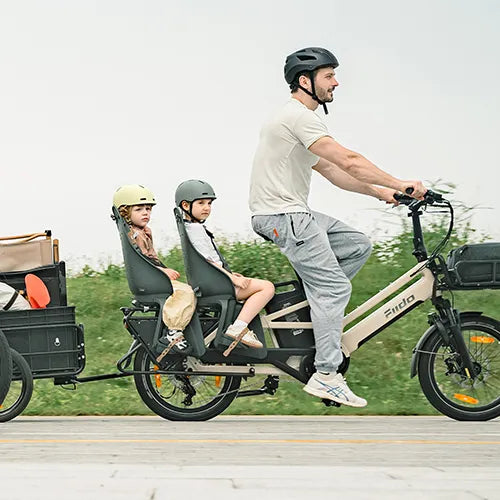
Electric Cargo Bike: Heavy-Duty Payload & Family Utility
Choose best cargo e-bike: 440 pounds payload, stable, long-range performance, 12+ accessories for smart carry. Perfect for transporting groceries, gear, kids, pets effortlessly. Versatile, powerful, and ready to replace your car for every city errand and adventures.
Learn more
-
T2The upgraded, versatile electric cargo bike with longer tail built for family hauling - groceries, pets, 1-2 kids, with a massive 200 kg capacity. Engineered for safe, long rides across all terrains and in any weather.Sale price £1,454.00 Regular price £1,635.00Pick your color : Forest greenForest green
- Forest green
- Gray
Edition : StandardStandard- Standard
- Family Edition
- Multi-Purpose, All-Terrain
- 4-Piston Hydraulic Disc Brakes
- Large Battery Capacity
- High-Torque Motor
Add to compare of 4 selected Compare![]()
The Fiido T2 is a long-tail electric cargo bike, perfect for transporting goods or traveling with friends. With a 200kg load capacity and a range of up to 110km, it’s ideal for deliveries and shared adventures. Equipped with a powerful motor, wide tires, and a front oil-spring suspension system, it delivers stable power and a comfortable riding experience, effortlessly handling various terrains.
Learn more -
![]()
The Fiido T3 is a compact cargo e-bike made for modern family life. A 100Nm mid-drive motor, 972Wh removable battery, and 150kg payload make it equally capable of school runs, grocery trips, and daily commuting. With up to 120km of range, NFC unlocking, and room for up to two children, it keeps everyday transport simple and practical. Its battery is also compatible with the T3 Max dual-battery setup, making it a natural companion for families who ride together.
Learn more -
![]() Learn more
Learn more
Why Fiido?
Learn more
Advantages of Fiido Cargo E-Bikes
Fiido electric cargo bikes bring a whole new riding experience! Designed for heavy loads, they feature spacious cargo areas, making it easy to carry groceries, deliveries, or essentials for family outings. Equipped with powerful hydraulic brakes with power cut-off protection and a long-lasting battery, these bikes allow you to zip through the city or tackle challenging terrains with ease. They also help you avoid traffic congestion and reduce high driving costs, saving you time and money while providing a smooth and enjoyable ride.
Electric Cargo Bike FAQs
-
How Much Weight Can a Cargo E-Bike Carry?
Most cargo e-bikes typically carry around 135–250 kg (300–550 lbs) of total payload, depending on the frame design and whether the load is carried on a rear rack, longtail platform or front box. In general, carrying heavier loads can reduce real-world range, so it is important to consider payload capacity and range together when choosing a cargo e-bike.
For example, the Fiido T3 Max supports up to 200 kg (440 lbs) of total payload, while its dual-battery version offers up to 199 miles (321 km) of claimed range. This makes it a strong option for riders who need both substantial carrying capacity and extended range.
-
What Is the Maximum Weight Capacity (Payload) of an Electric Cargo Bike?
Most cargo e-bikes can carry around 135–250 kg (300–550 lbs) of total payload, depending on the frame design, cargo position and model. The payload normally includes the rider, passengers and cargo, so the bike’s total rated payload matters more than the capacity of an individual rack or platform.
For riders who need higher capacity, models such as the Fiido T2 and T3 Max can carry up to 200 kg (440 lbs). The T3 Max also combines this payload with a 100 Nm mid-drive motor and a dual-battery option, making it a practical choice when both heavy loads and longer rides matter.
-
Can a Cargo E-Bike Carry Children or Passengers?
Yes, but only if the cargo e-bike is designed for passenger transport and equipped with the required safety components. Never carry passengers on a standard utility-bike luggage rack, and always stay within the manufacturer’s load limits because excess weight can affect stability, handling and braking.
For example, the Fiido T2 is designed for passenger transport and has a reinforced rear frame with a total payload capacity of up to 200 kg (440 lbs). Use compatible passenger equipment and follow the manufacturer’s weight, age and installation requirements.
-
How Far Can a Cargo E-Bike Go on a Single Charge?
Cargo e-bike range varies widely by battery capacity, motor, rider and cargo weight, terrain, weather and assist level. Most models offer around 25–62 miles (40–100 km) of claimed range on a single charge, while long-range cargo e-bikes can go considerably farther.
The Fiido T2 offers up to 85 miles (136 km), while the Fiido T3 Max can reach up to 199 miles (321 km) with its dual-battery setup. These figures are claimed maximum ranges and actual range will vary with riding conditions.
-
What Are the Advantages of a Cargo Electric Bike?
A cargo e-bike can carry children, groceries, pets, work equipment and other heavy loads while making everyday trips more practical than using a standard bike or car. Key advantages include high carrying capacity, easier transport on hills, comfortable loaded riding and lower-cost short-distance travel.
The Fiido T3 is suited to city errands and school runs, the T2 offers greater family and mixed-terrain capacity, and the T3 Max combines high-load capability with longer-range potential.
-
What Are the Different Types of Cargo E-Bikes?
Cargo e-bikes generally fall into three main layouts: longtail, short-tail or compact, and front-loader/box designs.
Longtails extend the rear of the bike for passengers or cargo, front-loaders place the load ahead of the rider, and compact cargo bikes use a smaller footprint for urban use.
The Fiido T2 and T3 Max are longtail examples.
-
Is a Cargo E-Bike the Same as a Family E-Bike?
Not exactly. A cargo e-bike is designed primarily to carry people or goods, while a family e-bike focuses more specifically on transporting children and everyday family trips.
Many family e-bikes are longtail cargo e-bikes.
-
Short-Tail vs. Longtail Cargo E-Bikes: Which Is Better?
A short-tail is easier to manoeuvre and store, while a longtail offers more rear space for passengers and heavier loads.
The Fiido T3 uses a compact short-tail design; the Fiido T2 and T3 Max are longtail models.
-
Cargo Front-Loader vs. Longtail E-Bike: Which One Should You Choose?
- Choose a longtail e-bike if you want narrower dimensions, familiar handling and passenger or cargo space behind the rider. The Fiido T2 supports up to 200 kg (440 lbs).
- Choose a front-loader if bulky cargo or a dedicated front box is more important. Front-loaders are generally wider and require more storage space.
- Choose a longtail e-bike if you want narrower dimensions, familiar handling and passenger or cargo space behind the rider. The Fiido T2 supports up to 200 kg (440 lbs).
-
What Is the Best Cargo E-Bike for Families?
The best family cargo e-bike should balance passenger capacity, range, comfort, safety and everyday practicality.
The Fiido T3 Max combines up to 200 kg (440 lbs) of total payload with a dual-battery setup offering up to 199 miles (321 km) of claimed range.
-
Can I Use a Cargo E-Bike for Groceries, Deliveries or Commuting?
Yes. Their practical range depends on battery size, load, terrain and assistance level.
- 500–750Wh cargo e-bikes: around 25–43 miles (40–70 km).
- 900–1,000Wh+ long-range cargo e-bikes: around 50–80+ miles (80–130+ km).
The Fiido T2 uses a 998.4Wh battery and offers up to 84.7 miles (136.26 km) of claimed range in ECO mode.
- 500–750Wh cargo e-bikes: around 25–43 miles (40–70 km).
-
Are Cargo E-Bikes Legal to Ride on UK Roads?
Yes, provided the bike meets the UK rules for an Electrically Assisted Pedal Cycle (EAPC). It must have pedals capable of propelling the bike, a continuous rated motor output no greater than 250W, and electrical assistance must cut off above 15.5 mph (25 km/h).
-
What Can a Cargo E-Bike Be Used For? What Are the Most Common Use Cases?
Cargo e-bikes can be used for children, shopping, commuting, pets, deliveries, work equipment and outdoor trips.
The Fiido T2 is suited to family and everyday utility riding, while the T3 Max adds high payload capacity, extended range and portable power.
-
Can an Electric Cargo Bike Replace a Car?
In some situations, yes—but not completely.
A cargo e-bike can replace school-run, shopping, commuting and local-delivery trips. Models such as the T2 and T3 Max support up to 200 kg total payload, while the T3 Max offers up to 1620Wh.
In practice, it can replace many everyday car trips, particularly as an alternative to a second car.
Awards & Certification


Designed for All Riding Conditions

Riders All Around the World
SSL Encrypted Payments

2-Year Warranty

Riders' Reviews

Fast Customer Service

30-Day Return

Rapid and Free Domestic Shipping

Why Own an E-Bike?
The question really should be, why wouldn't you own one? E-bikes have skyrocketed in popularity for a reason.
Beyond just being enjoyable, they provide the flexibility and freedom to explore wherever and however you wish.
Tailor your ride to your energy level, mood, and goals—deciding how much effort to put in and how far to go. E-bikes help you avoid injuries from overstraining, eliminate the worry of being too tired to return home, and keep your commute sweat-free. Contrary to the belief that e-bikes are for the lazy, studies show that e-bike owners actually cycle much more than those on traditional bikes, thanks to the expanded possibilities e-bikes offer.
Get an Electric Bike and Upgrade Your Travel
Fiido is an e-mobility brand at the very core of the biking revolution, part of a wider smart and eco mobility revolution that is reshaping our world.
For decades, the market has been flooded with e-bikes that seem impressive but in reality lack real standout features. Fiido is changing that. We are among the few companies that are pushing the boundaries of technology. With the user experience enhanced, ebikes are now no longer just quirky gadgets—they've become a travel tool for everyone.
Why not kick off your smart mobility journey today?
Tailor your ride to your energy level, mood, and goals—deciding how much effort to put in and how far to go. E-bikes help you avoid injuries from overstraining, eliminate the worry of being too tired to return home, and keep your commute sweat-free. Contrary to the belief that e-bikes are for the lazy, studies show that e-bike owners actually cycle much more than those on traditional bikes, thanks to the expanded possibilities e-bikes offer.
Get an Electric Bike and Upgrade Your Travel
Fiido is an e-mobility brand at the very core of the biking revolution, part of a wider smart and eco mobility revolution that is reshaping our world.
For decades, the market has been flooded with e-bikes that seem impressive but in reality lack real standout features. Fiido is changing that. We are among the few companies that are pushing the boundaries of technology. With the user experience enhanced, ebikes are now no longer just quirky gadgets—they've become a travel tool for everyone.
Why not kick off your smart mobility journey today?
Learn more
Blog posts
View all
E-bike 101
Can an E-Bike Replace a Car? The Latest Ultimate Comparison
Table of Contents
Key Takeaways
E-Bike vs. Car at a Glance
E-Bike vs. Car: 10 Key Differences Compared
E-Bike vs. Car: When to Choose Each? Pra...

World Triathlon 2026 Finals Open as E-Bikes Enter Event Operations
PONTEVEDRA, Spain — September 23, 2026 — As the 2026 World Triathlon Championship Finals open in Pontevedra today, the five-day international compe...
